
Physics-Driven Hybrid Intelligence: The Next Frontier in Chemical Process Optimization


Introduction
Machine learning (ML) and artificial intelligence (AI) are increasingly being applied across the chemical and refining industries. While traditional ML approaches have enabled faster insights, soft sensors, anomaly detection, and predictive analytics, opportunities still exist to enhance their performance when processes exhibit highly nonlinear or dynamic behavior.
In such cases, physics-driven hybrid intelligence, where first-principle models are combined with data-driven learning, has been explored as a complementary approach to improve robustness, interpretability, and adaptability.
Role of Traditional Machine Learning in Chemical Processes
Traditional ML has already added significant value in industrial environments:
- Rapid pattern recognition: ML models can identify complex correlations in large datasets much faster than manual or rule-based methods.
- Quick deployment: Pure ML solutions can often be developed and deployed faster than physics-based simulators.
- Versatility: ML can be applied to soft sensors, anomaly detection, energy forecasting, and product quality prediction.
- Adaptable to new data: Pure data-driven systems can continuously learn when new high-quality data is available.
At the same time, certain challenges have been observed:
- Data limitations: Chemical plants frequently have sparse or noisy datasets.
- Time-varying dynamics: Nonlinear and drift-prone processes may reduce long-term accuracy.
- Limited extrapolation: ML models generally perform best within the data distribution on which they were trained.
- Interpretability: Black-box predictions may require care when used in safety-critical decisions.
These aspects have encouraged exploration of complementary approaches such as hybrid intelligence.
Physics-Driven Hybrid Intelligence
Hybrid AI combines first-principle knowledge, such as mass/energy balances, reaction kinetics, and thermodynamics, with ML algorithms. Instead of replacing ML, hybrid intelligence is intended to augment it by providing physics-based constraints and structure.
Potential Benefits of Hybrid AI
- Lower dependency on large datasets by using domain knowledge.
- Improved generalization when operating conditions shift outside the historical range.
- Physically consistent predictions, which may increase trust and interpretability.
- Enhanced stability when processes experience drift, fouling, or catalyst aging.
Where Hybrid Intelligence Makes the Biggest Difference
Hybrid modeling tends to be most effective in use cases where both physical understanding and data-driven adaptability are required. Typical categories include:
- Quality soft sensors
Estimation of difficult-to-measure variables such as polymer properties, refinery specification parameters, fertilizer nutrient composition, or intermediate quality indices. - Energy-intensive process units
Fired heaters, boilers, evaporators, heat exchangers, and distillation columns where thermodynamics and heat-transfer physics strongly influence performance. - Reaction systems with aging effects
Reformers, crackers, hydrogenation units, and catalytic reactors where catalyst deactivation, fouling, or poisoning gradually alters process behavior. - Predictive maintenance under variable conditions
Rotating equipment such as compressors, pumps, and turbines operating under fluctuating loads, feeds, and ambient conditions.
These categories highlight scenarios where pure ML or pure physics alone may be insufficient, and where hybrid intelligence can provide incremental robustness and stability.
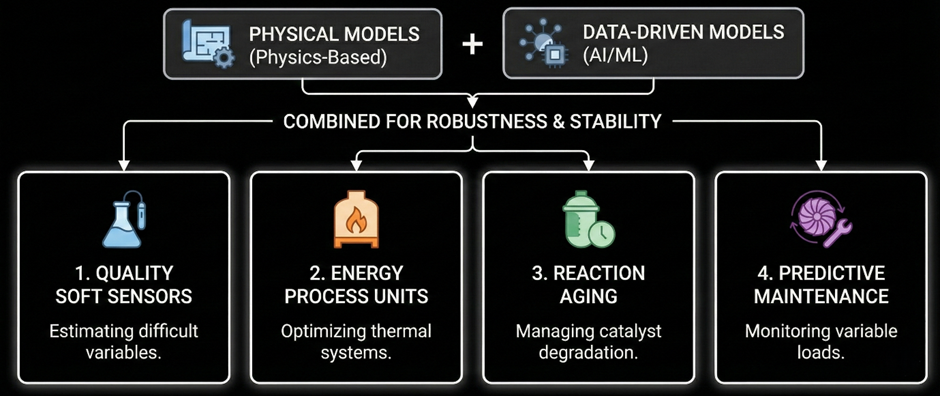
Fig: Hybrid modelling opportunities
Approach for Implementation
- Data Collection and Preprocessing: Gather historical plant data along with simulation data from physics-based models.
- Model Development: Develop baseline physical models and augment them with ML components focused on residuals or parameter tuning.
- Training and Validation: Use hybrid loss functions combining data fitting and physical constraints; validate with unseen operational scenarios.
- Deployment: Integrate hybrid models into APC or process monitoring systems, enabling real-time or near-real-time predictions.
- Continuous Learning: Adapt models dynamically to changing plant conditions with retraining and physics-guided updates.
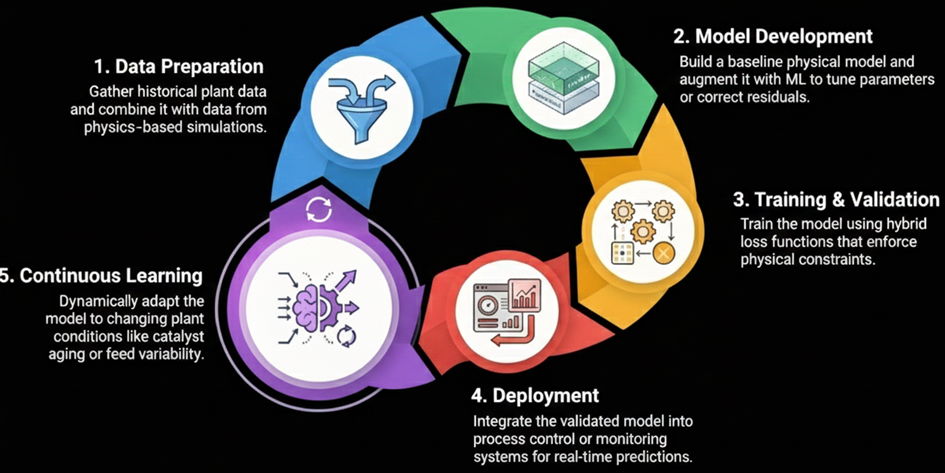
Fig: Implementation Cycle
Observed Performance Improvements
- Prediction accuracy: Hybrid models often maintain performance across wider operating conditions.
- Process stability: Tighter control of quality variables and reduced oscillation may be observed.
- Operational gains: Case studies report improved reliability, 5–15% energy savings, and reduced quality giveaway.
- Reduced manual tuning: Models can be updated in alignment with changes such as catalyst deactivation or feed variability.
Conclusion
Pure ML and physics-driven hybrid AI are both valuable approaches within chemical operations, each offering unique strengths. While pure ML provides adaptability and rapid deployment, hybrid intelligence introduces a physics-based structure that can improve robustness in complex or highly dynamic processes.
Together, these approaches form a complementary toolkit that can support more efficient, reliable, and insight-driven plant optimization. For more details, reach out to us
References
- Zhang, L., et al. (2023)
"Physics-informed machine learning for FCC riser reactor modeling"
Chemical Engineering Journal (related works cited in systematic reviews) - Sai, B. P., et al. (2022)
"Industrial data science – a review of machine learning applications for the process industry"
Reaction Chemistry & Engineering, 7(4), 589-612