
AI-Driven Optimization of Refinery Preheat Train and Exchanger Networks


Introduction
In refinery operations, crude and vacuum preheat trains represent one of the largest opportunities for energy recovery and fuel savings. A typical preheat train consists of dozens of heat exchangers arranged in series and parallel, recovering heat from multiple hot streams such as column pump-arounds, product draws, and side strippers before the crude enters the fired heater.
Over time, fouling in individual exchangers or flow imbalance across parallel paths reduces heat recovery efficiency. The impact is rarely localized degradation in a single exchanger that propagates across the entire network, leading to higher furnace duty, increased fuel consumption, throughput constraints, and elevated CO₂ emissions.
Traditional monitoring approaches struggle to manage this complexity. Fixed KPIs and exchanger-level thresholds do not capture network interactions or changing operating conditions. Artificial Intelligence (AI) enables a shift from reactive fouling management to holistic, network-level performance optimization.
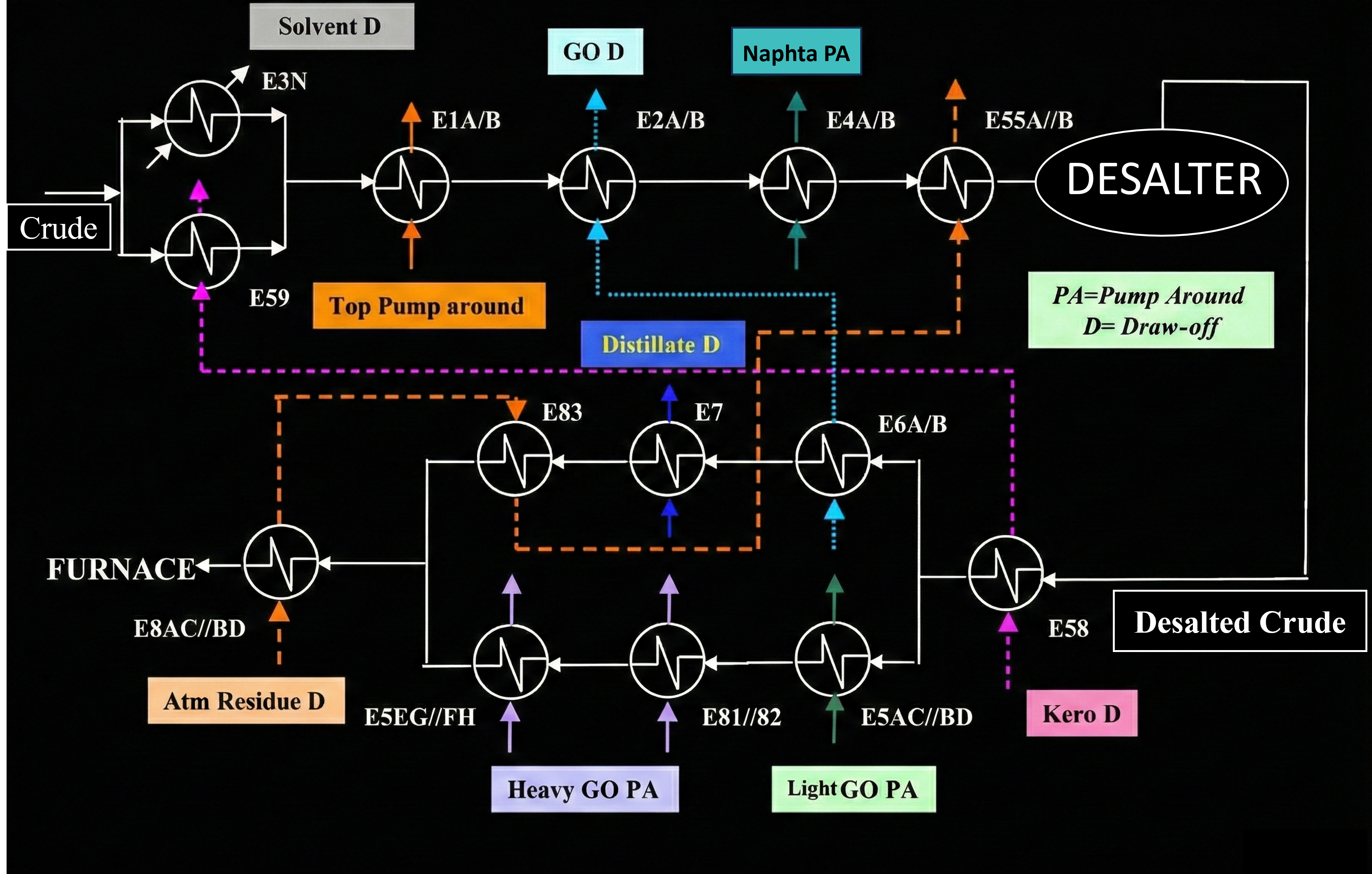
Fig: General Preheat Train Schematic
How is AI useful
AI models are particularly effective in preheat trains because of their ability to learn complex, multivariate behavior across interconnected exchangers.
By analyzing temperatures, flows, pressures, and operating states across the entire network, AI can:
- Establish a dynamic clean-performance baseline for each exchanger under varying crude rates and blends
- Distinguish fouling-driven degradation from normal operational changes
- Identify exchanger bottlenecks that limit overall heat recovery
- Quantify how fouling in one exchanger impacts downstream temperature profiles and fired heater duty
Unlike conventional methods that evaluate exchangers in isolation, AI captures system-level interactions enabling engineers to understand where intervention will deliver the maximum energy benefit for the entire preheat train.
Approach: Network-Level Intelligence and Decision Support
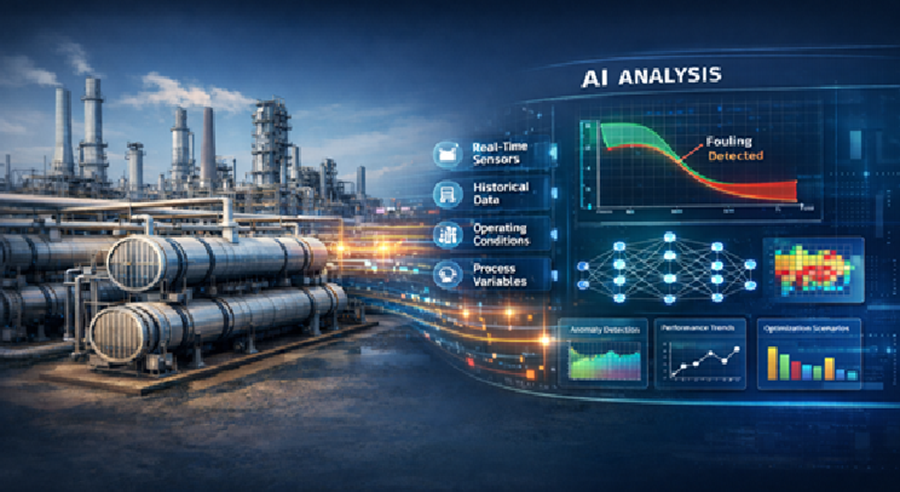
Fig: Real-Time Exchanger Visualization
AI-driven preheat train optimization follows a structured methodology:
- Network Data Contextualization
All exchanger measurements are mapped to the physical preheat train configuration, including series-parallel flow paths, bypass conditions, and operating modes.
- Expected Performance Modeling
Machine learning models learn expected outlet temperatures and heat recovery for each exchanger as a function of crude rate, blend properties, and upstream conditions.
- Fouling Detection and Propagation Analysis
Performance deviations are continuously tracked to identify where fouling initiates
and how it propagates across the network.
- What-if and Forecasting Scenarios
AI forecasts future exchanger performance and evaluates scenarios such as exchanger cleaning, flow redistribution, or operating condition changes.
- Economic Optimization of Cleaning Strategy
Rather than cleaning exchangers based on fixed schedules, the system ranks cleaning actions based on recoverable energy, avoided furnace fuel consumption, throughput impact, and maintenance cost.
This approach enables refinery teams to prioritize the right exchanger at the right time maximizing total network benefit instead of local improvements.
Benefits for refinery operations
Refineries implementing AI-driven preheat train optimization typically achieve:
- 3–6% reduction in fired heater fuel consumption
- Improved furnace inlet temperature stability
- Higher unit throughput without additional firing
- Optimized exchanger cleaning schedules
- Lower CO₂ emissions and improved energy intensity metrics
Equally important, AI provides explainable insights that engineers can validate and trust, ensuring adoption across operations and reliability teams.
Conclusion
In modern refineries, individual preheat train exchangers can no longer be managed as isolated assets. Their performance must be optimized as an integrated energy system.
AI enables this transformation by combining network-level intelligence, performance forecasting, and economic optimization into a single decision-support framework. The result is sustained heat recovery, lower energy consumption, and more reliable operations.
As refineries face increasing pressure to improve margins and reduce emissions, AI-driven exchanger network optimization is emerging as a critical capability for achieving intelligent, sustainable refining.
References
- Negri, V. A., et al. (2025).
Data-driven fouling detection in refinery preheat train heat exchangers using neural networks and gradient boosting. Sensors, 25(16), 4936