
Transforming Alarm Overload into Structured Operational Insight


Introduction
Modern alarm management is no longer about thresholds; it’s about operational intelligence.

Alarm systems are essential for safety and reliability, yet in many plants, they still increase risk. Alarm floods, unclear prioritization, and delayed responses especially during abnormal operating conditions, remain common. A single disturbance can trigger hundreds of alarms within minutes, many stemming from the same root cause. Instead of enabling fast action, operators are forced to interpret raw alerts under pressure.
Why Traditional Alarm Systems Fail?
Most plants don’t have too few alarms they have too many undifferentiated ones.
Over time, alarms are added without clear intent, ownership, or defined operator response. Everything appears critical. During disturbances, alarm floods overwhelm operators exactly when clarity matters most.
ISA-18.2 has long emphasized that alarms must be purposeful, actionable, and manageable. Yet alarms are still treated as by-products of signals rather than as designed operational instruments. Without structure and governance, alarm systems lose effectiveness and trust.
From Alarms to Agentic Intelligence
Traditional systems detect threshold violations.
Agentic alarm intelligence understands operational meaning.
Instead of asking “Did a limit get crossed?”, alarm agents evaluate:
- Is the condition persistent or transient?
- What equipment or process context does it belong to?
- Which alarms are related?
- Does this require action now?
- How should this be presented to an operator?
This directly aligns with ISA-18.2 principles: every alarm must have a clear intent, severity, and response. Agents enforce this continuously through contextual reasoning not documentation alone.
What an Agentic Alarm Architecture Looks Like
Agentic alarm intelligence is not a single algorithm it is an architectural pattern.
At its core, it introduces autonomous, governed agents that operate across the alarm lifecycle:
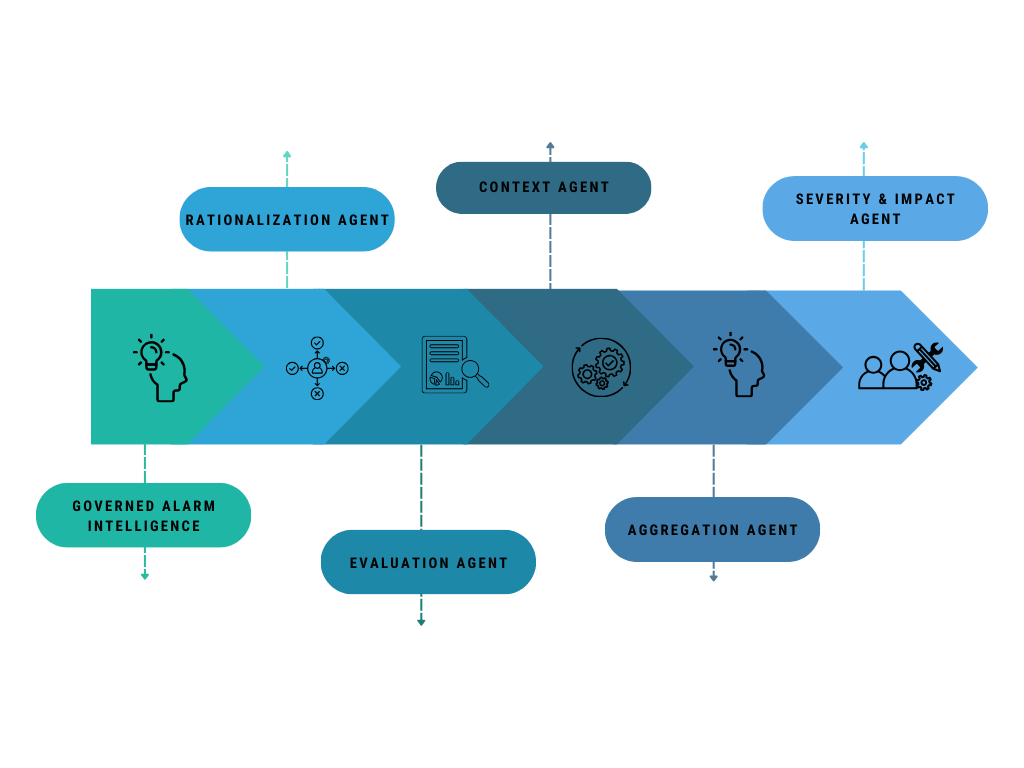
Fig Agentic Alarm Intelligence Workflow
The result is not simply fewer alarms.
There are fewer decisions operators must make under pressure.
How the Operator Experience Changes
Operators no longer react to alarm floods.
They see prioritized, condition-based summaries with built-in context and clear severity.
Cognitive load drops. Trust increases.
Operators focus on action, not interpretation exactly as alarm management standards intended.
Why This Matters Beyond the Control Room
Agentic alarm intelligence delivers measurable value:
- Clearer visibility of safety-critical conditions
- Faster identification of real issues, reducing downtime
- Governed, auditable alarm behavior for engineering teams
- Greater confidence in operational risk for leadership
Most importantly, it shifts organizations from reactive firefighting to proactive control.
A Foundation for Intelligent Decision Support
Once alarms are structured and trusted, they become the foundation for assistive operational agents.
These agents support the plant operators by answering:
- Why is this happening now?
- What related conditions matter?
- Where should attention go first?
- What has happened in similar situations before?
This is not a future leap.
It is the natural next step of doing alarm management right.
Conclusion
Alarm management is not a configuration task; it is a decision workflow.
Modern alarm management is about agentic operational intelligence: delivering the right insight, in the right context, at the right time while remaining fully aligned with ISA-18.2.
By treating alarms as intelligent, governed agents rather than passive alerts, industrial organizations move beyond alarm overload toward safer, clearer, and more resilient operations.